Free guide · no email required
Local SEO for Car Dealerships
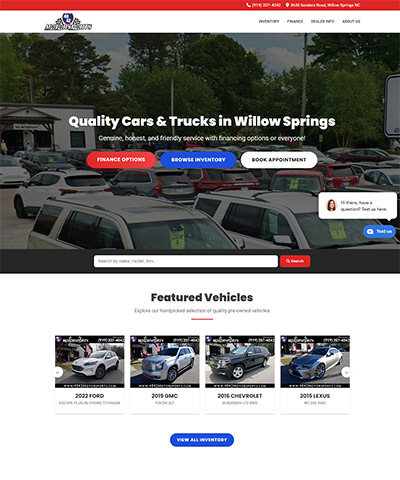
Local SEO for a car dealership means winning three surfaces inside roughly a 25-mile radius: the Google map pack, the local organic results, and now the AI answers that name nearby dealers. You win them with a maxed-out Google Business Profile, steady reviews with real photos, matching listings across the web, and pages written for the buyers near you. You do not win them by outspending Autotrader - and the good news is you don't have to.
Why local is the only fight worth picking
Search "used cars for sale" and the results are national marketplaces with nine-figure ad budgets. That fight is over before it starts. But a buyer in your county searching "used car dealerships near me" triggers a different result: the map pack - three local businesses, above the organic links, chosen by proximity, relevance, and reputation.
National sites can't compete for that placement. They have no lot on Elm Street, no reviews from your neighbors, no photo of a real building. Local search is the one arena where a 30-car independent outranks a billion-dollar marketplace, and it's where your actual buyers - people within driving distance holding a down payment - are searching.
The map pack: proximity, relevance, prominence
Google picks the three map results using where the searcher is standing, how well your profile matches what they typed, and how established you look. You can't move your lot, so the work is the other two:
- Relevance comes from a complete profile: right primary category ("Used car dealer"), services filled in, body styles listed under Products, a description that says what you sell in plain words.
- Prominence comes from reviews, photos, activity, and consistent listings. A profile with 80 reviews, weekly posts, and 40 real photos reads as an established business. A claimed-and-abandoned profile reads as a maybe.
In our case study, profile-to-website clicks went from 88 to 551 in 90 days without moving the lot an inch. The profile surfaced for 414 searches, and the top terms were all "near me" queries from buyers who'd never heard of the dealership.
Reviews are a ranking factor, not decoration
Volume, recency, and responses all feed the map pack - and reviews do double duty as the thing buyers actually read before driving over. The system that keeps them coming:
- A QR code on the closing paperwork, so the review happens at the desk instead of "later."
- The delivery photo taken on the customer's own phone - it usually rides along when they post.
- A response to every review within two days. The negative ones matter most - future buyers read your answer, not just the complaint.
Listings: the same name, address, and phone - everywhere
Google cross-checks you against the rest of the web. Google, Bing, Apple Maps, Yelp, Yellow Pages, Nextdoor, Facebook - every listing with matching details is a vote that you're a real, established business. Mismatched phone numbers and old addresses are votes against. It's tedious, unglamorous work, which is why most lots never finish it and why it still separates dealers who do.
The local pages national sites can't write
Here's the piece almost every dealer skips. Google and the AI chats reward pages that prove local knowledge - and no national platform can fake yours:
- Near a college? A page about affordable, reliable cars for students, with those cars on it.
- In the mountains? A page on trucks and 4x4s that names the actual roads and trailheads buyers drive to.
- A commuter town? A page for the under-$15k gas-sipper crowd, mentioning the highways they sit on every morning.
Write for a specific nearby buyer, name real places, and put the matching inventory on the page. One warning: this is not the templated "used cars in [city]" page trick - that's a doorway page, and Google now de-indexes them. One real page for a real buyer beats forty fakes, and after March 2026 the forty fakes are a penalty risk.
Local links from people who actually know you
The Chamber of Commerce in your town and the two next door. The little league sponsor page. The high school boosters. Each one is a trusted local site linking to yours - the kind of link no competitor can order from a spam vendor - and each puts your name in front of families who buy cars. Budget $300-400 a year per Chamber, and most will announce your membership to their whole mailing list when you join.
What about AI SEO and GEO?
When a buyer asks ChatGPT or Google's AI where to buy a used truck nearby, the answer is assembled from the same local signals: your profile, your reviews, your listings, and pages that answer the question. That's what AI SEO - or GEO, generative engine optimization - actually is for a local dealer. There is no separate "AI trick" to buy. Do the work above and you're in the answer pool; skip it and no add-on service puts you there.
Do it yourself, or hand it off
Everything on this page is doable by a dealer with patience and a phone. Most never do it - not because it's hard, but because it never becomes anyone's job. That's the actual reason local SEO works for the lots that commit to it.
If you'd rather sell cars while someone else does this: the Own Your Town plan - $750 a month - is this exact playbook with your name on it: profile, posts, citations, reviews, and buyer pages, run for you. Month-to-month, no contract.
Want to know where your lot stands locally?
Call or text and we'll walk your map pack, profile, and reviews with you - free, same business day.